Custom Graduation Stole Ordering Timeline
Custom Graduation Stole Ordering Timeline
The custom graduation stole timeline trips up more student organizations than any other piece of the graduation experience. Embroidery deadlines, bulk production runs, and ground shipping windows all stack on top of each other, and most campus organizations only place this order once a year — so the learning curve resets every spring. This guide walks through a 14-week timeline that keeps cost, quality, and delivery on track.
Why the custom graduation stole timeline matters
Graduation ceremonies are immovable. A stole that ships a day late may as well not ship at all. Compounding the issue: embroidery houses run capacity-limited in March and April, exactly when most graduation stole orders land. Plan early and you’ll lock the lowest per-unit price and the cleanest production. Plan late and you’ll pay rush fees on top of a stripped-down decoration spec.
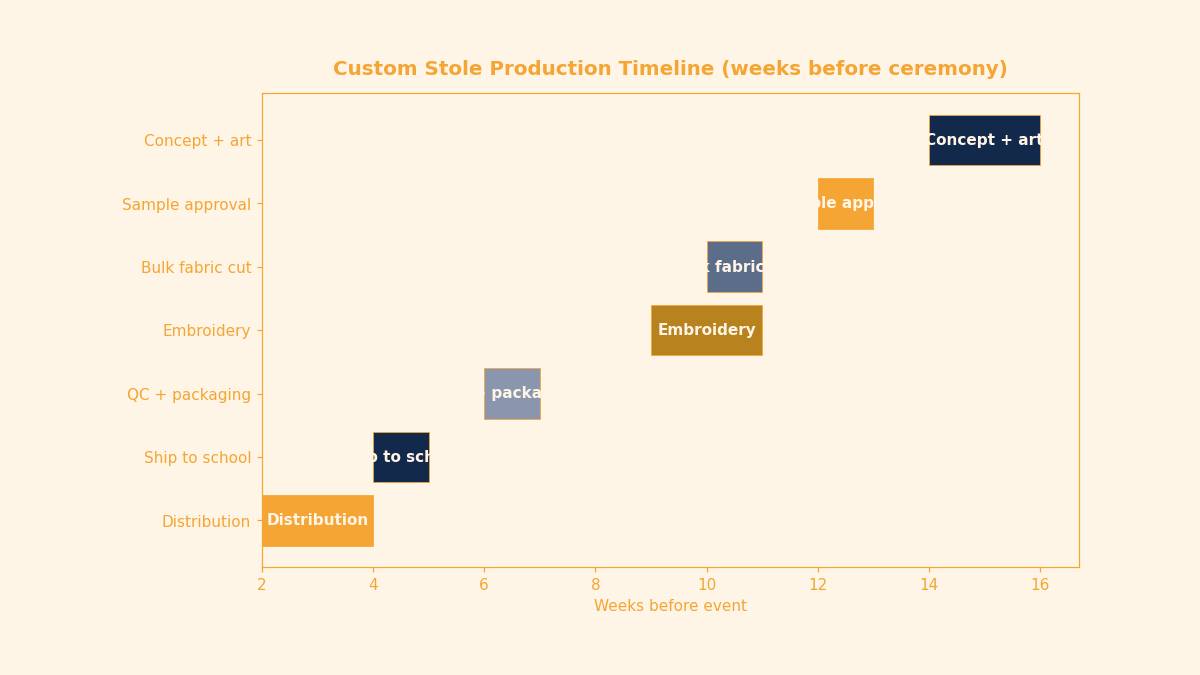
The timeline above maps seven stages of custom graduation stole timeline work. Concept and art finalize at week 14. Sample approval lands at week 12. Bulk fabric cutting runs in week 10. Embroidery runs across weeks 9-7. QC and packaging happen at week 6. Shipping to the school occurs at weeks 5-4. On-campus distribution starts at week 2.
Decoration method changes the timeline
Heat transfer vinyl is the rush-friendly option at roughly 5 business days. Screen print runs about 8 business days. Embroidery runs 12 business days. Patch and applique work runs 14 business days. Foil applique runs 16 days. If you’re inside the 8-week window, you’re likely choosing heat transfer or screen print regardless of design preference.
Embroidery is the gold standard for stoles
Embroidered stoles look more premium, feel more substantial, and photograph more cleanly than heat-transfer alternatives. For organizations that order stoles annually, embroidery is worth the longer lead time. The thread color, logo size, and placement all matter — confirm the embroidery proof against the organization’s brand guide before approving production.
Bulk discounts by order size
Per-stole pricing flattens past 500 units. The steepest savings happen between 50 and 250 units. A 25-stole order runs roughly $38 per stole; a 100-stole order runs $26; a 500-stole order runs $17. If your organization graduates 80-120 students in a year, order at the 100 tier and hold 5-10% spare inventory for last-minute additions.
How to handle last-minute requests
Last-minute graduates are the bane of stole orders. Plan one of two strategies. First, hold spare inventory at 5-10% of base order — works well for repeat orders with predictable name patterns. Second, place a small follow-up order with heat-transfer decoration only — works for unexpected name swaps that show up in the final two weeks.
Production capacity by season
March and April are peak season for graduation stole embroidery. Order capacity tightens in mid-February. December and January are the safest months to place a spring graduation order — capacity is wide open and most embroidery houses offer slight discounts to fill the slow season.
Common pitfalls
Three errors cost organizations real money on graduation stole orders. First, missing the design approval window — every day past the approval deadline pushes the bulk production date proportionally. Second, ordering without a confirmed name list — name-embroidered stoles can’t start until the list is locked. Third, choosing rush shipping at the end — that 3-day rush charge adds 5-8% to the order total and is almost always avoidable with cleaner upstream planning.
Brief the supplier the right way
A clean brief includes six items: organization name, graduation date, quantity, fabric (polyester satin vs bridal satin), decoration method (embroidery vs heat transfer), and the design file. With those six items the supplier can quote within 24 hours and start production within a week of payment.
Distribution on campus
Plan to receive stoles at the campus organization office two weeks before graduation. Distribute at the senior banquet, the awards ceremony, or a dedicated pickup window. Some organizations distribute stoles at the ceremony itself, but on-the-day handouts increase the risk of name mismatches and missing graduates.
Bottom line
A clean custom graduation stole timeline starts 14 weeks before graduation and ends 2 weeks before the ceremony. Approve art at week 14, embroidery starts at week 9, and inventory arrives on campus at week 2. Lock the name list early, order at the 100 or 250 tier for the best per-unit savings, and your organization will distribute stoles that look professional and arrive on time.
Ready to spec your graduation stoles? Try our stole builder, browse stock colors, or read the companion guide on honor cord vs stole vs sash.