
Bulk Graduation Stoles for Schools: Pricing, Specs & Timeline
Bulk Graduation Stoles for Schools: Pricing, Specs & Timeline
Ordering bulk graduation stoles is one of those tasks that lands on an administrator’s desk once a year and has to go perfectly the first time. Whether you are a registrar outfitting 400 seniors, an advisor ordering for a program cohort, or a graduation coordinator standardizing regalia across departments, the fundamentals are the same: lock the spec early, price by tier, and build the timeline backward from your ceremony date. This guide covers everything schools need to know about bulk graduation stoles, including wholesale pricing, fabric and sizing specs, personalization options, and a proven ordering calendar.
What Counts as a Bulk Order?
Most suppliers treat 25 pieces as the entry point for quantity pricing, with meaningful breaks at 50, 100, 250, and 500 units. Below 25, you are effectively paying small-group rates. Above 500, pricing is usually quoted per project, because setup, thread, and freight get amortized so widely that per-piece costs approach the raw material floor.
Bulk graduation stoles for schools generally fall into three spec categories:
- Plain stock stoles: single-color satin, no decoration, used for color-coding programs or honor levels.
- Standard decorated stoles: one embroidered element repeated across every piece, such as the school seal, program name, or class year.
- Personalized stoles: shared base design plus each student’s name, which adds a per-piece personalization charge and a data-collection step.
Bulk Pricing: What Schools Actually Pay
Per-piece pricing falls fast as quantity climbs. The chart below shows typical per-stole pricing for a standard decorated stole (school seal embroidery, one location) across common school order sizes.
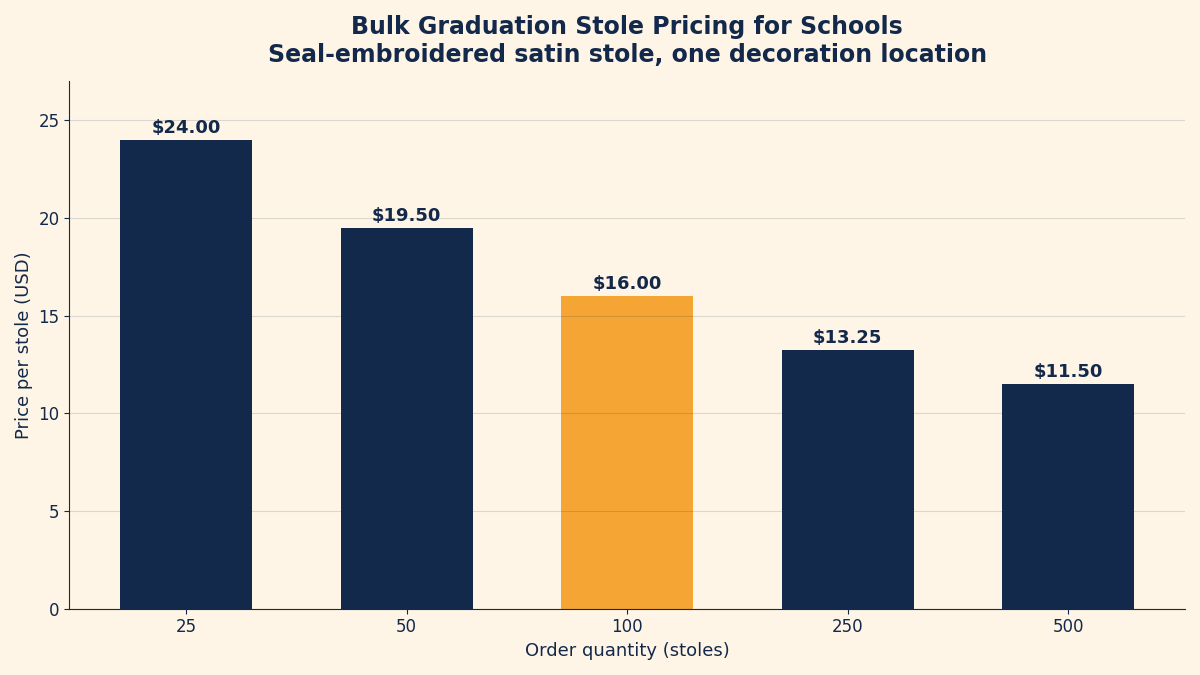
A few practical notes on reading that chart. First, plain stock stoles run roughly 40 percent below these figures, while per-name personalization typically adds $4 to $6 per piece at any tier. Second, one-time setup and digitizing fees of $40 to $75 apply to new artwork, but disappear on reorders once your seal is on file. Third, freight is the quiet budget line: 250 stoles ship in about four cartons, and ground freight adds well under a dollar per piece if you avoid rush windows.
Specs That Matter on a School Order
When you request quotes, suppliers will assume defaults unless you specify otherwise. These are the spec decisions worth making deliberately:
| Spec | Standard Option | What to Confirm |
|---|---|---|
| Length | 72″ end to end | 60″ option for middle school ceremonies |
| Fabric | Bridal satin, 200–230 gsm | Ask for a physical swatch to verify color match |
| End style | Angled (fishtail) ends | Pointed or straight-cut available at same price |
| Decoration | Embroidered seal, one panel | Stitch count drives cost; simplify fine seal detail |
| Trim | Self-color binding | Contrast trim adds a premium look for ~$1/piece |
| Packaging | Bulk-packed by carton | Individual polybags with name labels simplify distribution |
One spec deserves special emphasis: color consistency. Satin dye lots vary, so if you order across multiple purchase orders or academic years, ask your supplier to hold your dye lot reference. A stage full of seniors in two visibly different golds is the kind of detail that shows up in every photo.
The School Ordering Timeline
Bulk production is predictable when you respect the phases. The chart below shows where the weeks actually go on a typical 250-piece decorated order.
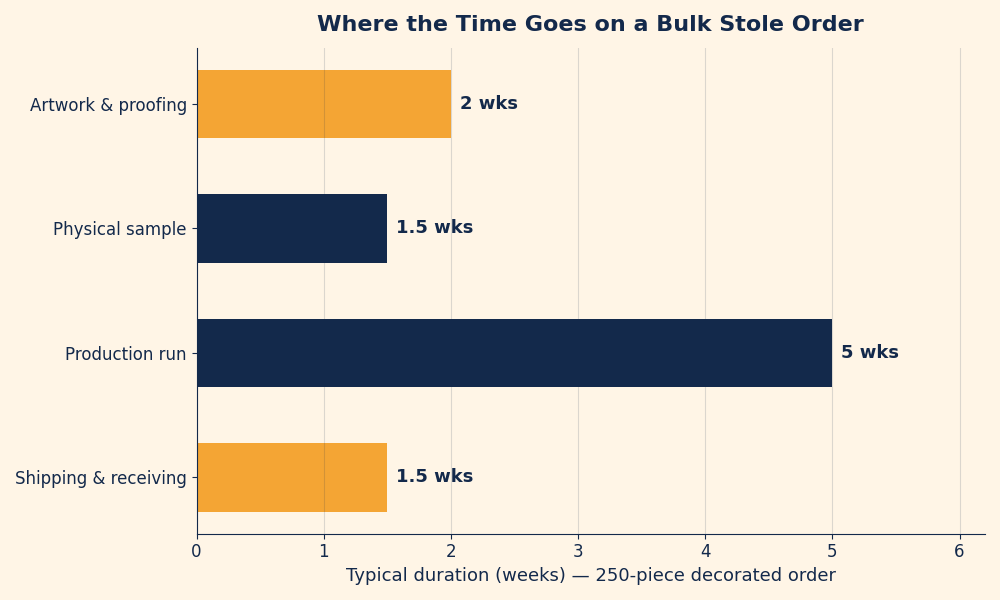
Working backward from a late-May commencement, that means requesting quotes in January, approving artwork by mid-February, and releasing the full order by early March. Schools that also collect student names for personalization should add two weeks up front for data collection and cleanup; misspelled names discovered after stitching are the single most expensive category of bulk-order error.
A Simple Milestone Calendar
- 16 weeks out: finalize quantity estimate, request quotes, confirm budget approval.
- 13 weeks out: approve digital proof and physical sample.
- 10 weeks out: release full production with final counts and name data.
- 4 weeks out: receive delivery, count cartons, spot-check embroidery.
- 2 weeks out: distribute or stage by homeroom, program, or alphabet.
Who Should Get Which Stole?
Many schools run a two- or three-tier system: a standard stole for all graduates, a distinct color for honor levels, and specialty stoles for student organizations. Keep the system simple enough to police at the door. Two or three colors with clear criteria works; seven categories invites confusion on ceremony morning. Program-level orders, such as nursing pinnings and career-technical completions, are usually easiest handled as separate small bulk orders with their own artwork.
Greek organizations on your campus typically order separately through their chapters rather than through the registrar. If your student life office fields those questions, point chapters to our guide on greek graduation stoles for fraternities and sororities, which covers letters, crests, and chapter group ordering.
Reordering and Multi-Year Programs
The first bulk order is the hard one. After that, your artwork is digitized, your colors are on file, and your counts have a baseline. Schools that treat stoles as an annual program rather than an annual scramble typically set a standing spec document, reorder in January with updated counts, and review the design only when branding changes. At Custom Grad Stoles we keep school files on record indefinitely, and our production team flags dye lot changes proactively. You can read more about how we support school programs on our about page, or browse regalia planning articles on our blog.
Common Questions from School Buyers
Can we mix colors within one order and keep bulk pricing?
Usually yes, within reason. Most suppliers will treat an order of 300 stoles split across two or three colors as a single quantity tier, because the cutting and sewing work is identical. What breaks the tier is artwork changes: three colors with the same seal is one setup, but three different embroidery designs is three setups, each with its own digitizing and machine time. If your honor levels use different artwork, ask for combined-quantity pricing explicitly; many vendors will grant it if you ask and quote higher if you don’t.
What about purchase orders and school payment terms?
Established regalia suppliers routinely accept school and district purchase orders with net-30 terms, but confirm this before you build your calendar. First-time accounts sometimes require a deposit before production starts, and a payment approval that sits in accounts payable for two weeks can quietly consume your sampling window. Get the PO issued at the quote-approval milestone, not the production-release one.
Should students buy their own stoles instead?
Some schools shift the cost to families through the bookstore or a graduation packet. It works, but you give up two things: guaranteed color consistency across the stage, and predictable counts. Schools that centralize the purchase and either absorb the cost or bill it as a graduation fee consistently report smoother ceremony mornings.
Bulk Order Checklist
Before you sign off on a quote, confirm you can answer yes to each of these: quantity locked with overage included; artwork approved as a stitched sample, not just a screen proof; length and end style specified; packaging method chosen; delivery date at least two weeks before the ceremony; reorder terms and artwork storage confirmed in writing. If all six are covered, your order is effectively de-risked.
Get School Pricing on Your Stole Order
Tell us your headcount, colors, and ceremony date. We’ll send tiered pricing, a free digital proof, and a delivery guarantee that beats your deadline.
Get a Quote