Kids’ Graduation Stoles: Sizing and Ordering for Preschool Through 8th Grade
Preschool, kindergarten, and end-of-elementary promotions have quietly become full ceremonies, complete with tiny caps and stoles. If you are a teacher, a room parent, or a PTA volunteer ordering for a class of four- and five-year-olds, the instinct is to buy a scaled-down version of the high school stole. That instinct causes most of the fit and budget problems these orders run into. A children’s graduation stole is its own category, with its own length, its own durability demands, and its own design rules. Here is how to specify one that looks right on a small graduate and survives the day.
Why a kids’ stole is not just a smaller adult stole
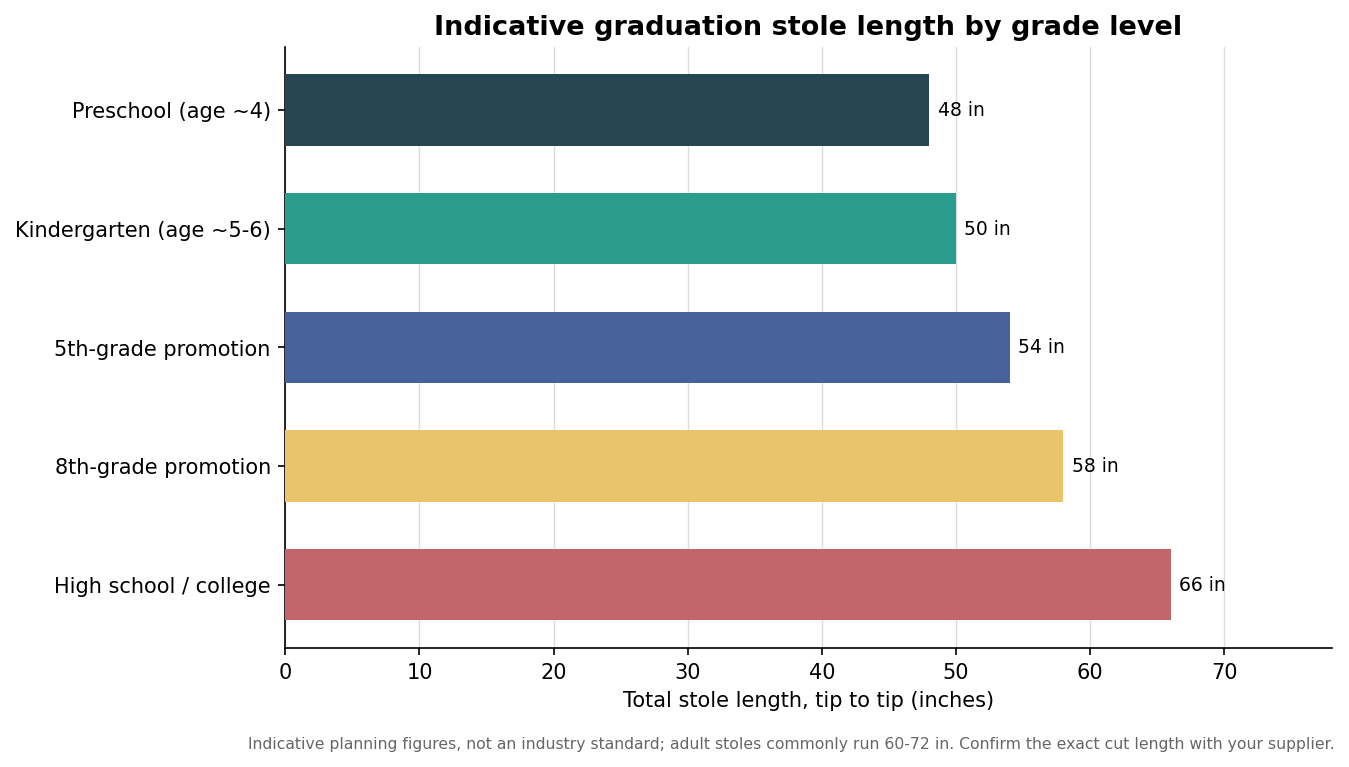
The obvious difference is length, and it matters more than any other spec. An adult stole commonly runs 60 to 72 inches tip to tip, which drapes past the knees on a small child and turns into a tripping hazard on stage. Children’s stoles are cut much shorter, and the versions marketed for preschool and kindergarten frequently land around 48 to 50 inches total. That shorter drop keeps the ends near waist height, which reads correctly in photos and, more importantly, keeps a nervous five-year-old from stepping on the hem while climbing stairs.
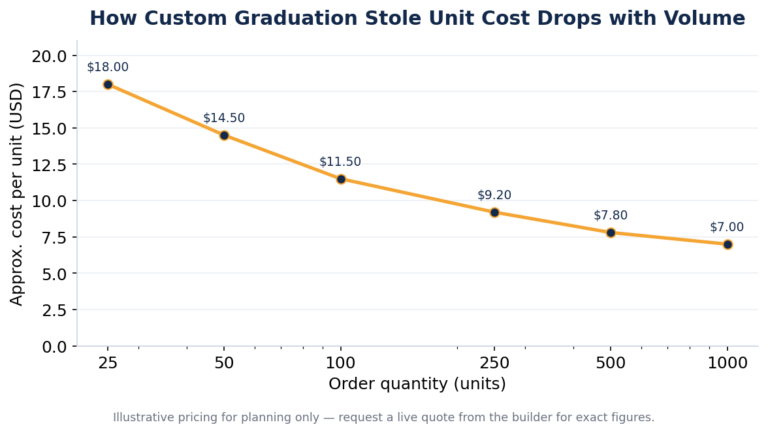
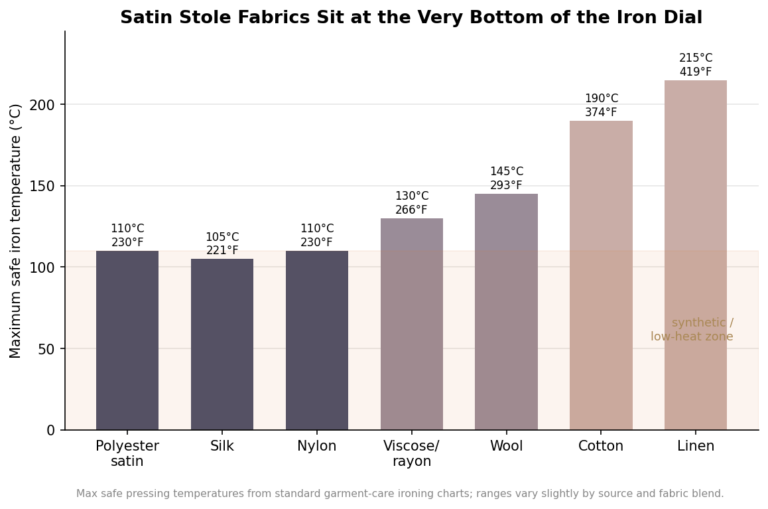
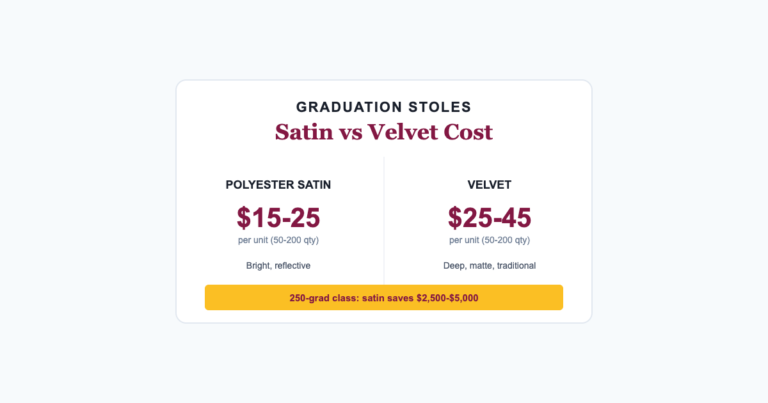
Durability is the second difference. These stoles get worn by children who will sit on the floor, wipe their hands on them, and ball them up in a backpack. A lighter satin with clean edge stitching handles that better than a heavy velvet, and it presses flat again more easily the morning of the ceremony. Budget is the third: parents are rarely paying premium regalia prices for a preschool keepsake, so the order usually needs to hit a low per-unit cost across the whole class rather than lavish detail on any one piece.
Sizing by grade and age
Length should track the graduate, not the calendar. As a rough planning guide, preschoolers do well near 48 inches, kindergartners around 50, a fifth-grade promotion near 54, and an eighth-grade promotion closer to 58 before you reach the adult range at high school. The chart below lays out those indicative lengths side by side so you can pick a single size for a mixed-age group without guessing.
Width deserves a moment too, because a stole that is proportionally too wide overwhelms a small frame and buries the artwork in folds. Narrower stoles, roughly three to four inches per side for the youngest grades, sit better on little shoulders and photograph cleaner. Width scales up with the graduate, as the second chart shows. Treat both charts as starting points for a conversation with your supplier rather than fixed standards, and if your group spans several ages, size to the middle of the range and confirm the shortest child will not trip.

Designing artwork that reads at small scale
Small stoles punish busy designs. The single most common mistake on a children’s order is cramming a school name, a mascot, a year, and a slogan onto a panel that is only a few inches wide, at which point none of it is legible from a parent’s seat. Pick one hero element, usually the graduation year or the school name, set it large and simple, and let everything else be secondary. High-contrast color pairings, dark text on a light stole or the reverse, survive the distance between the stage and the back row far better than tonal or pastel-on-pastel combinations.
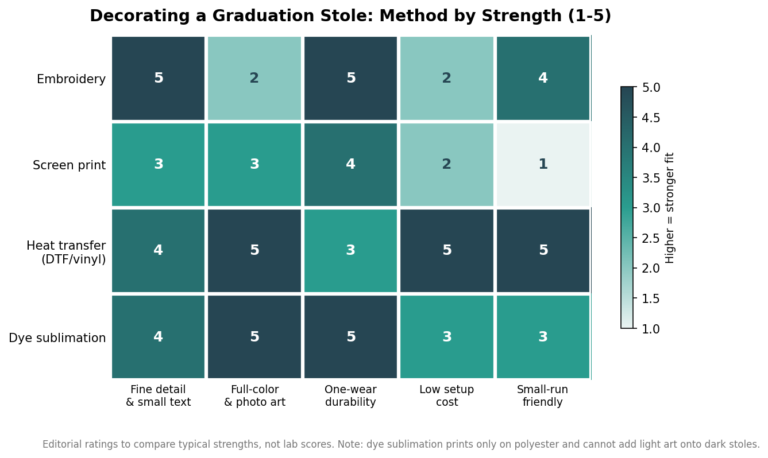
Decide early whether you are printing one side or both. A single front panel with the year is the most economical and is plenty for a keepsake. If you want the school name on one side and the year on the other, confirm the decoration method supports it cleanly, because embroidery, screen print, and sublimation each behave differently on a narrow child’s stole. For very young grads, avoid tiny script fonts and thin strokes; a bold, rounded typeface holds up when it is stitched or printed small.
Ordering for a whole class
Class orders live or die on a few logistics. First, count generously: order a handful of spares beyond your roster, because a lost stole or a last-minute enrollment on ceremony week is common and reprinting one piece is slow and expensive. Second, decide between a single shared design for the entire class, which keeps unit cost lowest and production simplest, and individual names, which are lovely but add setup and lengthen the timeline. For most preschool and kindergarten programs, one clean class design is the practical choice.
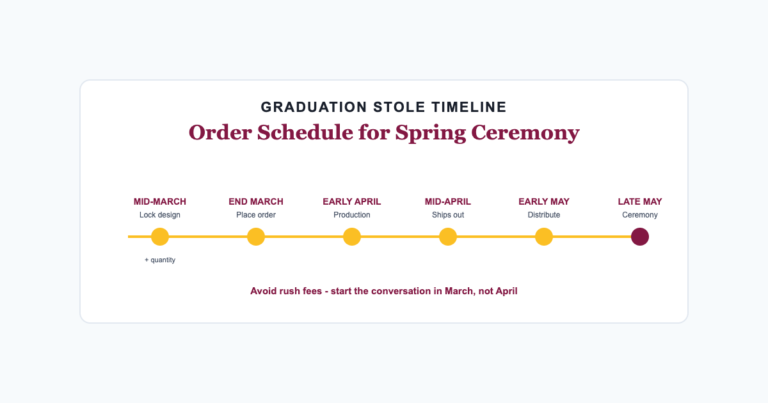
Third, protect your timeline. Spring ceremonies cluster in a narrow window, so suppliers get busiest exactly when you need them; place the order well ahead of your date and build in time to approve a physical proof before the full run prints. Confirm the total length, the width, the exact wording, and the color against the school’s actual shade before you approve, since a royal blue on screen can differ from the stole in hand.
Fit, safety, and the keepsake afterward
On ceremony day, the stole should rest evenly over both shoulders with the ends hanging free and clear of the feet. If a child is on the smaller side of your group, a stole even a few inches too long is worth swapping rather than risking a stumble on stage. After the event these pieces usually become keepsakes, so a stole that presses flat and stores without permanent creases earns its keep. Specify the shorter youth length, keep the artwork bold and simple, order a few extras, and lock the design with a proof, and a room full of small graduates will look the part without the day turning into a wardrobe problem.