Honor Cords vs Graduation Stoles: What Each Signifies
Honor Cords vs Graduation Stoles: What Each Signifies
Walk any commencement stage and you will see a swirl of regalia layered over the standard cap and gown, twisted cords here, draped sashes there, each one meaning something specific. For students and advisors planning what to wear, the honor cords vs stoles question comes up constantly, because the two look different, cost differently, and signify different kinds of achievement. Choosing the right one is not just aesthetics; it is about accurately telling the story of what a graduate accomplished.
This guide settles the honor cords vs stoles debate by explaining what each traditionally represents, how they differ in cost and visibility, and how schools and organizations decide which to award, so you can make a confident, correct choice for your graduates.
What honor cords signify
Honor cords are twisted ropes with tassels on each end, worn draped around the neck and over the shoulders. Traditionally they signal academic distinction: membership in an honor society, a GPA threshold like cum laude, or completion of a specific honors program. Their meaning is carried almost entirely by color, and a single graduate may wear several at once, one for each honor earned, layered together. Because they are compact and relatively inexpensive, cords are the natural way to recognize a large group of high-achieving students affordably.
When multiple cords stack up
A student in three honor societies can wear three cords together, each color telling a different part of their story. This stacking is part of the appeal: cords let a graduate display several distinctions at once without cluttering the gown. The flip side is that once several cords pile up, individual meanings can blur for onlookers, which is where a stole’s larger, clearer identity has the advantage.
What graduation stoles signify
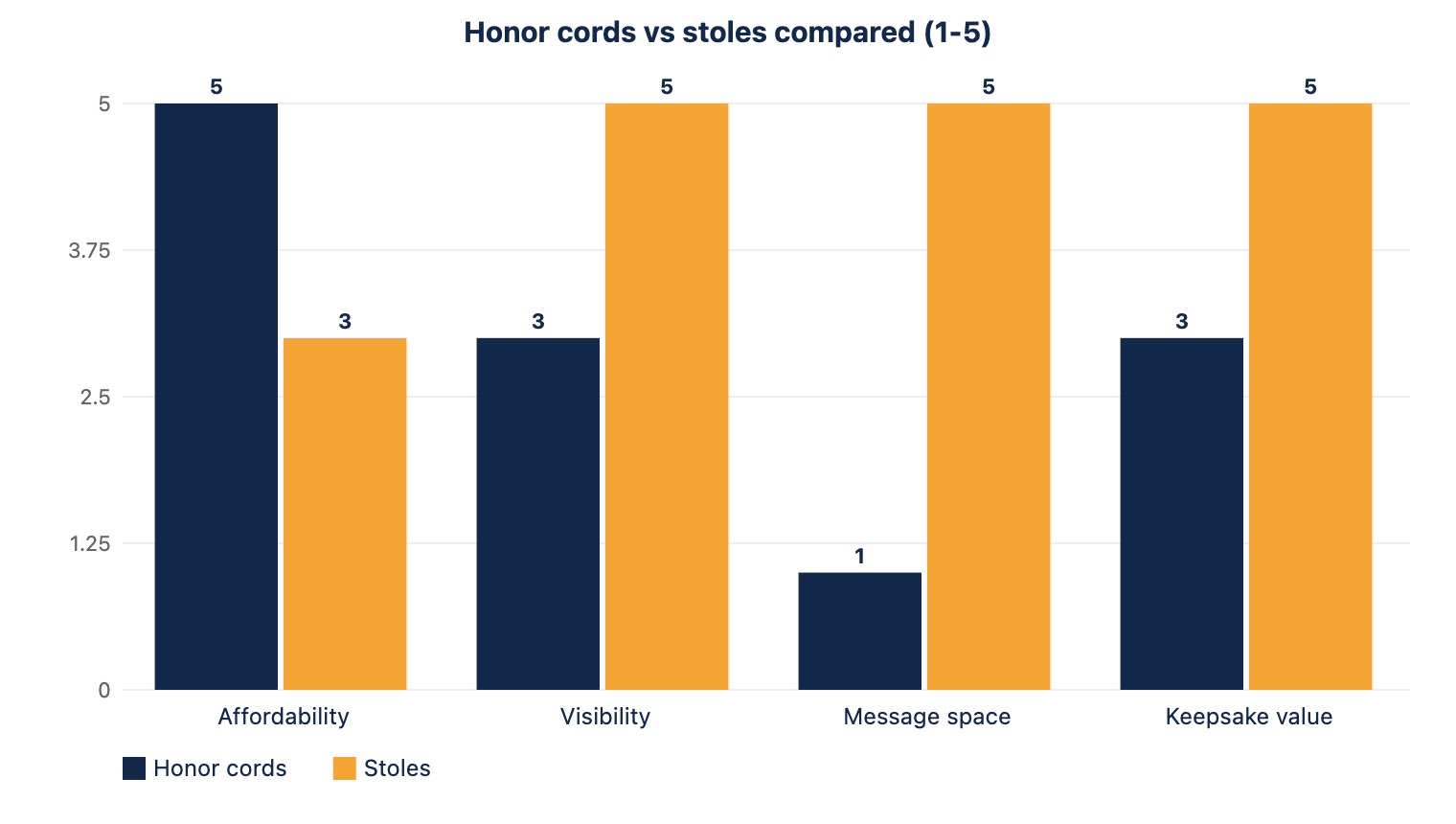
Stoles, sometimes called sashes, are wide strips of fabric worn over the shoulders and hanging down the front of the gown. Their broad surface makes them ideal for carrying words and symbols, an organization’s name, a cultural heritage, a department, a Greek letter, or embroidered text and logos. Where a cord says “this student earned an honor,” a stole can say exactly which honor, which group, or which identity, in letters everyone in the audience can read. That expressive space is the stole’s defining advantage.
The practical differences
Beyond meaning, the two differ in ways that matter to a budget and a keepsake. Cords are cheaper per unit and quick to source, which suits recognizing many students at once. Stoles cost more, especially when customized with embroidery, but they read clearly from the audience and make a far better keepsake, students frame them, hang them, and keep them for decades. Visibility, too, favors stoles: a cord can disappear against a dark gown from a distance, while a stole reads instantly.
| Attribute | Honor cords | Graduation stoles |
|---|---|---|
| Cost per unit | Lower | Higher |
| Carries text / logo | No | Yes |
| Visibility from audience | Moderate | High |
| Can stack multiple | Yes | Usually one |
| Keepsake value | Good | Excellent |
How schools and groups decide
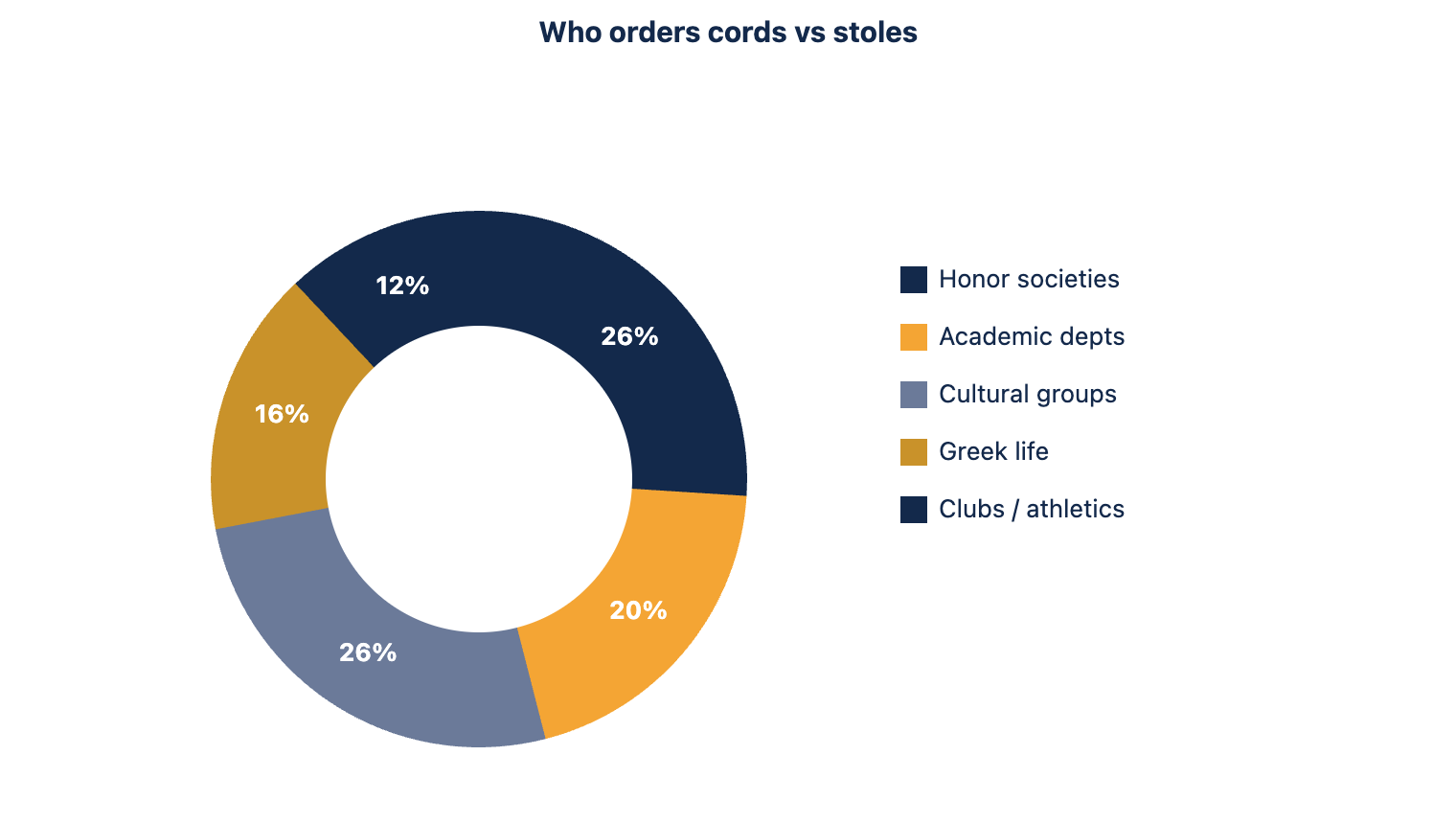
The choice usually follows the kind of recognition. Honor societies and academic distinctions lean toward cords because they are traditional, affordable at volume, and stackable. Cultural organizations, departments, Greek life, and identity-based groups favor stoles because they want to display a name or symbol clearly. Many graduates end up wearing both, cords for their honors and a stole for their community, which is not a contradiction but a fuller telling of their college story. There is rarely a single right answer; there is the answer that best represents the achievement.
Regalia etiquette and school policy
Before ordering either, check the institution’s rules. Some schools specify which cords and stoles are officially sanctioned, where they may be worn, and whether personal or unofficial items are allowed on stage. Confirming policy early prevents the heartbreak of a graduate being asked to remove regalia at the last minute. When a group introduces a new stole or cord, coordinating with the commencement office in advance keeps everyone on the same page.
Colors and their meanings
Because color does the talking for cords, and often for stoles, it helps to understand the loose conventions behind it. Gold or yellow frequently marks top academic honors and the sciences; white is associated with arts and letters; various blues, greens, and other shades map to specific disciplines and societies. These conventions are traditions rather than universal law, and different honor societies assign their own official colors, so always confirm the exact shade a given honor requires rather than assuming. Getting a color subtly wrong can imply a different distinction than the one a student actually earned.
Combining regalia gracefully
When a graduate wears several pieces, a little coordination keeps the look intentional rather than busy. Cords sit closest to the neck, a stole drapes over them, and any medallion or pin finishes the front. Advising students to plan the full ensemble in advance, rather than piling items on the morning of, produces cleaner stage photos and ensures nothing obscures an important emblem. Groups issuing regalia can help by suggesting a simple layering order alongside the items themselves.
Quality and color accuracy
Whichever you choose, quality shows on stage and in photos. For cords, look for full, evenly twisted rope and secure tassels; thin, loosely wound cords look cheap up close. For stoles, prioritize a substantial fabric with a clean drape, straight edges, and crisp embroidery. Color accuracy matters too, since honor colors carry specific meaning, a color that prints slightly off can misrepresent the very distinction it is meant to signal, so confirm shades against a standard before a large run.
Bottom line
The honor cords vs stoles decision comes down to what you need to say. Cords economically and stackably signal academic honors through color; stoles use their broad surface to display names, symbols, and identity in letters the whole audience can read. Match the regalia to the achievement, check school policy, and insist on quality and accurate color, and your graduates will wear exactly the right story across the stage.
Order cords and stoles for your graduates
Tell us your honors, groups, and quantities and we will spec the right regalia with accurate colors and clean embroidery.
Get a QuoteHome · About · Buying guides · Companion guide: cultural graduation stoles