Military & ROTC Graduation Stoles: A Custom Ordering Guide
Military & ROTC Graduation Stoles: A Custom Ordering Guide
For service members, veterans, and ROTC cadets crossing the stage, a graduation stole is a chance to honor a chapter of service that shaped their degree. Military graduation stoles carry a branch seal, a unit or detachment name, and the pride of a commissioning class in a way a plain gown never could. Whether you are a cadet ordering one or a program buying for a whole detachment, getting the details and protocol right matters.
This guide covers what belongs on military graduation stoles, the decoration methods that hold up to the ceremony and beyond, and how to order for an individual or a full ROTC class.
What belongs on a military or ROTC stole
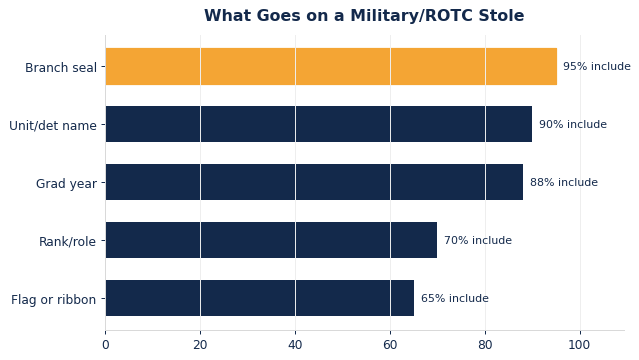
Most military graduation stoles combine a branch identity with the graduate’s specifics. The core elements are the branch seal or emblem, the unit or detachment name (for ROTC, the host school’s battalion or detachment), the graduation year, and often the graduate’s name or future rank. Some add a small flag or an honor ribbon. The chart shows how often each element is included.
Color follows branch and program convention — service colors, school colors, or a classic black stole with branch-colored embroidery. If your institution or program has protocol on regalia, confirm it before ordering so the stole is welcome on stage.
Individual vs detachment orders
An individual grad can personalize freely — name, branch, and year. A detachment or program ordering in bulk should standardize the shared elements (seal, detachment name, year) and personalize only the name, which keeps a commissioning class looking unified while still honoring each cadet.
Decoration methods that honor the moment
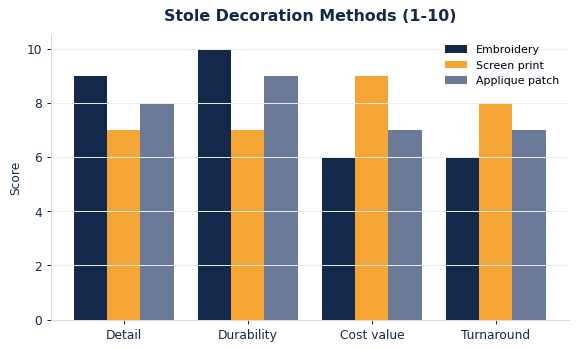
Embroidery is the standard for military graduation stoles because it delivers crisp seals and lettering with a premium, durable finish that becomes a keepsake. Screen printing is a budget-friendly option for large classes with simpler art, and applique patches suit detailed unit crests. The chart compares the methods.
Whatever the method, send high-resolution seal artwork and confirm official emblem usage where required. A clean, correctly rendered branch seal is what makes the stole read as authentic rather than generic.
Ordering for a program or class
The table below helps structure an order whether you are buying one stole or outfitting a detachment, with guidance on personalization and lead time.
| Order | Personalize | Lead time |
|---|---|---|
| Single cadet | Name, branch, year | Standard |
| Detachment (10–50) | Shared seal + individual names | Order 4-6 weeks out |
| Multi-branch event | Per-branch seals, one layout | Confirm all seals early |
Lock artwork and a name list early so embroidery keeps pace with commissioning and graduation dates. For font and thread guidance, see our companion Custom Stole Embroidery: Fonts, Threads & Artwork That Reads Clean, and browse styles across our custom graduation stoles range.
Getting seals and protocol right the first time
Nothing undermines a military graduation stole faster than a seal that is subtly wrong — stretched, off-color, or an outdated emblem. Because branch and unit seals often have usage guidelines, confirm the correct, current artwork and any permissions before you digitize it for embroidery. Sending a high-resolution vector of the official seal, rather than a screenshot pulled from a website, is the single biggest factor in whether the finished stole looks authentic or amateur.
Coordinate protocol alongside artwork. Some ceremonies place military stoles and cords freely; others specify who may wear what and where insignia sit. A quick conversation with the registrar or the ROTC cadre settles the rules before production, so a detachment’s stoles are welcomed on stage rather than pulled at the door. It also clarifies whether name, rank, or commissioning details are appropriate to include for your particular event.
For a class order, lock a single template and vary only the name. Standardizing the seal, detachment name, and year across every cadet keeps the commissioning class visually unified in photos, while individual names honor each graduate. Build in enough lead time that a full detachment’s stoles can be produced, proofed, and shipped before commissioning week — embroidery on dozens of stoles is not an overnight job, and a rushed proof is where seal errors slip through.
Proof one before you run fifty
Approve a single stitched sample — seal, colors, and lettering — before committing the full class run. A five-minute proof review prevents a boxed set of stoles with a flaw repeated fifty times.
Timing a class order around commissioning week
Military and ROTC calendars are unforgiving: commissioning and graduation land on fixed dates, and a stole that arrives late is useless. Work backward from ceremony day and give embroidery real room — several weeks for a full detachment, more if multiple branch seals are involved. The most common failure is not a production problem but a late artwork approval, so lock the seal, the detachment name, and the name list early and treat those as immovable once confirmed.
Multi-branch events add coordination that is worth handling deliberately. A single ceremony honoring Army, Navy, Air Force, and Marine cadets needs each branch’s correct seal and colors on one consistent stole layout, so the class looks unified while each graduate’s service is honored accurately. Assign one person to gather and verify every seal, because a mixed order is where a wrong or dated emblem most easily slips through when different cadets send their own artwork.
Give yourself a buffer for the human realities of a class order. Names get added, spellings get corrected, and a cadet’s commissioning status can change close to the date, so order a small overage of blank-name or extra stoles and confirm the final roster as late as production safely allows. A little slack in both timing and quantity turns a high-stakes deadline into a calm handoff, and it means every graduate crosses the stage wearing the honor they earned.
Plan the order like the ceremony it honors
Treat a military or ROTC stole order with the same discipline as the ceremony it marks: work backward from commissioning day, lock the seals and the name roster early, and give embroidery real lead time — more if several branch seals are involved. Assign one person to verify every seal against current official artwork, approve a stitched proof before the full run, and order a small overage to absorb late roster changes. Handled this way, a detachment’s stoles arrive correct, consistent, and on time, and every graduate crosses the stage wearing the honor they earned.
One more practical note: gather every graduate’s details in a single, clean spreadsheet — exact name spelling, branch, and any rank or role — and freeze it as early as the roster allows. A tidy, verified list is what lets a supplier produce a whole detachment’s stoles accurately in one run, and it removes the most common source of last-minute errors when different cadets each send their own artwork and details in different formats.
Frequently asked questions
Are military stoles allowed at all graduations?
Policies vary by institution. Many welcome military and ROTC stoles and cords, but some require approval. Confirm your school’s regalia rules before ordering.
Can we order matching stoles for a whole ROTC class?
Yes. We standardize the shared seal, detachment name, and year, then personalize each cadet’s name so the class looks unified on stage.
Ordering military or ROTC stoles?
Send your branch seals and names and we’ll spec stoles that honor the class.