Graduation Stole Sizes: How to Choose the Right Length and Width
Sizing is the detail most people skip when they order custom graduation stoles, and it is the one that shows up in every photo. A stole that is too short rides up around the collar; one that is too long swings past the knees and catches on the gown. Getting the length and width right is not complicated, but it does take a few deliberate measurements before you place a bulk order you cannot easily change. This guide walks through how to specify the right size, from total length down to end shape, so the stoles you receive drape the way you pictured them.
Start with total length, measured from the back of the neck
Graduation stoles are described by their total length, tip to tip – the full run of fabric if you laid it flat. Because the stole folds over the shoulders, each side hangs about half of that number. The two lengths you will see most often are 60 inches and 72 inches. A 60-inch stole drops roughly 30 inches down each side; a 72-inch stole drops about 36 inches. The simplest way to picture the finished look is to decide where you want the ends to fall, measure from the back of the neck down the front to that point, and double it.
The widely used guideline is that a stole should end somewhere between the waist and the mid-thigh. Ending at the waist looks cropped in a full-length gown; ending below the knee tends to tangle when the graduate walks or sits. Aim for the hem, and remember to measure while wearing the shoes planned for the ceremony, since a two-inch heel changes where everything lands.
Match length to the graduate’s height
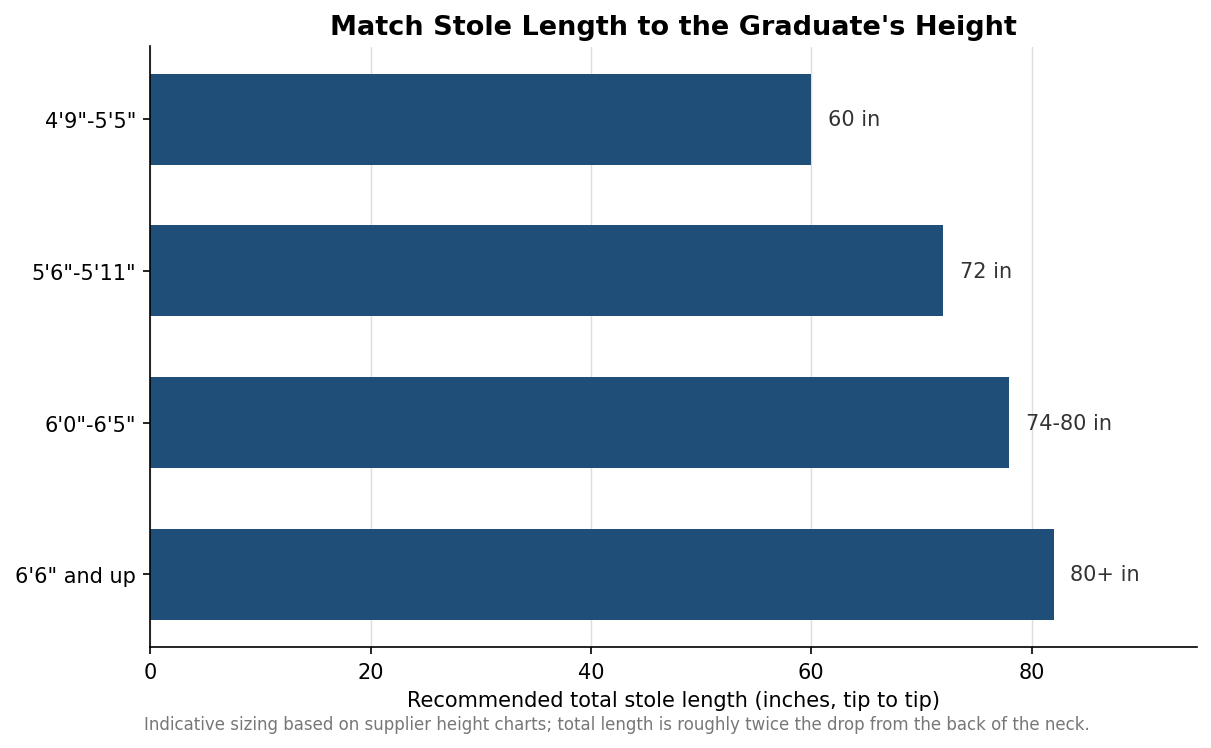
Height is the strongest predictor of the right length, which is why most suppliers publish a chart rather than a single size. As a rough map: graduates from about 4 feet 9 inches to 5 feet 5 inches are usually well served by a 60-inch stole; those from 5 feet 6 inches to 5 feet 11 inches by a 72-inch stole; and taller graduates by extended lengths in the 74 to 80-inch range. Anyone above roughly 6 feet 6 inches often wants 80 inches or more so the ends still reach the hem.
The chart below shows the pattern. Treat it as a starting point rather than a rule – a graduate who wants a longer, more dramatic drape can size up a step, and a petite frame can size down. When you are ordering for a whole class and cannot measure everyone, the 60-inch and 72-inch pairing covers the large majority of adults, with a small run of extended lengths held back for your tallest students.
One length rarely fits a whole group perfectly. If you are buying in bulk, ask whether your supplier can split a single order across two lengths at the same unit price. Many can, and it prevents the common outcome where a third of the class is swimming in fabric while another third looks like they borrowed a younger sibling’s stole.
Width and end shape change the look more than you expect
Stole width is easy to overlook and surprisingly visible in person. Straight satin stoles typically measure about 4.5 to 5 inches at the widest point, and some are gently tapered – narrower at the shoulder, around 3.5 inches, widening toward the ends near 5 inches. Kente and woven heritage stoles tend to run close to 4.5 inches. Wider is not automatically better: a stole much past 5 inches can look heavy on a smaller frame and can crowd honor cords worn underneath, while a narrow stole leaves less room for embroidered text or a large crest.
End shape is the other choice. A straight or blunt end gives you the most flat area for a logo, year, or block lettering. A V-cut or pointed end looks more formal and frames a centered emblem nicely, but it reduces the usable space near the tip, so long lines of text may need to sit higher up the panel. If your design has a lot of copy – a full program name plus a date, say – the straight end is the safer canvas. If the design is a single crest or monogram, the V-cut tends to look sharper.
Let the fabric and decoration method inform your final spec
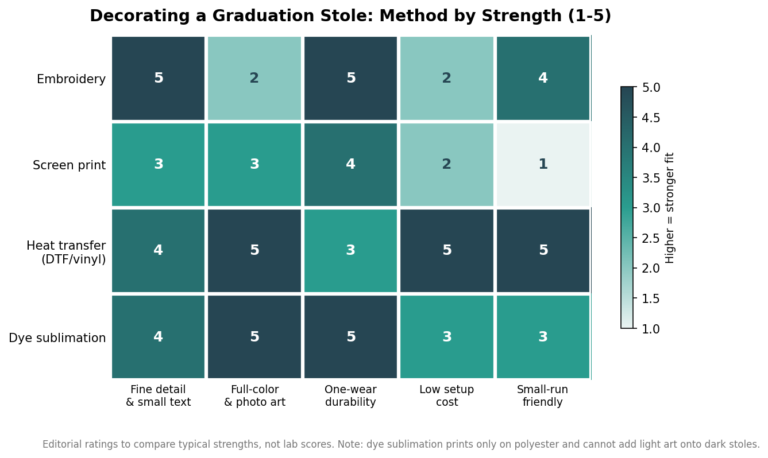
Most custom stoles are cut from satin because it presses flat, holds color, and takes both heat-applied graphics and embroidery. A heavier, thicker satin resists the puckering that can happen when embroidery is stitched onto a thin panel, and it hangs with a cleaner line. If your artwork is dense or you are stitching lettering on both sides, mention that to your supplier up front, because it can affect whether they recommend a stabilizer or a slightly wider panel. None of this changes your length choice, but it can nudge your width up a quarter inch to give the design breathing room.
Color matters here too, though not for sizing. Deep tones like maroon, royal, and forest green read well against dark gowns, while metallics and pastels can wash out under bright ceremony lighting in photos. That is a design decision rather than a measurement, but it is worth settling at the same time you lock the dimensions so the whole spec goes to production at once.
Build the production timeline into your size decision
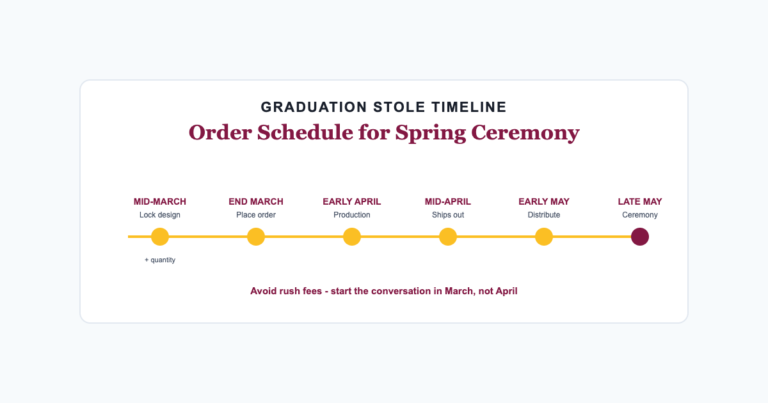
Sizing and scheduling are linked, because the moment you move from a blank stole to a decorated one, the lead time jumps. Blank or stock stoles often ship within one to three business days. Custom-decorated stoles – embroidery or a heat-applied transfer – commonly need about two to three weeks once artwork is approved, and complex designs or large bulk runs can stretch to roughly five weeks in peak season. The chart below shows those indicative ranges.
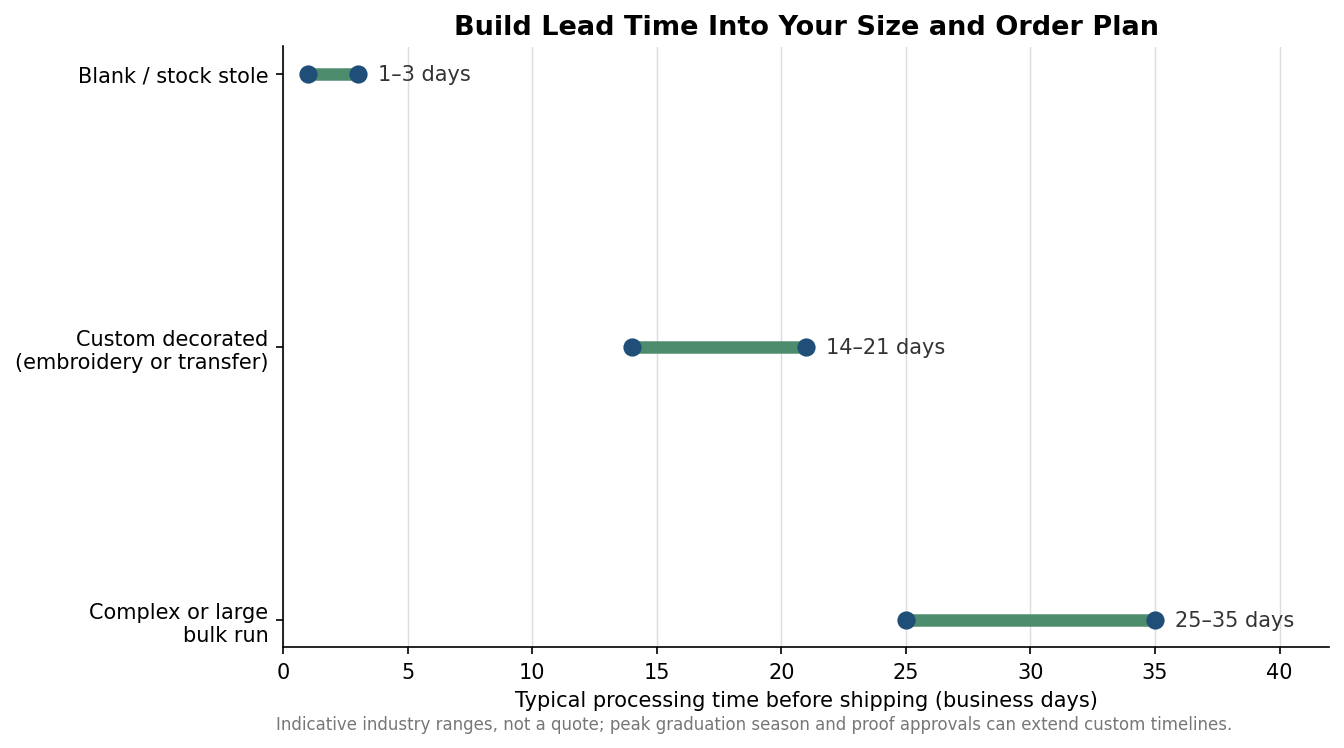
The practical takeaway is to finalize your measurements early. If you discover at the proof stage that you need to add an extended length for a handful of graduates, that change is trivial three weeks out and stressful three days out. Confirm your length split, your width, and your end shape before you approve artwork, and treat the approval date – not the ceremony date – as the real deadline. Order a few spares in your most common length as well; a lost or damaged stole the night before graduation is far easier to solve from a small buffer than from a rush reorder.
Specifying a stole comes down to four decisions made in order: total length matched to height, width matched to the design, end shape matched to the artwork, and a timeline matched to your decoration method. Settle those before you buy, and the stoles that arrive will hang evenly, photograph cleanly, and leave room for the details that make them personal.