Graduation Stole Colors & Meanings: A Complete Guide
Graduation Stole Colors and Meanings: A Complete Guide
Every color on a graduation stage means something, and understanding graduation stole colors helps schools, honor societies, and grads choose regalia that signals the right achievement. A stole’s color can indicate honors, a field of study, a cultural affiliation, or membership in an organization. This guide explains what common graduation stole colors mean and how to choose the right one for your program.
While there are broad conventions, colors are not universally standardized — each institution and society sets its own. That flexibility is exactly why custom stoles are so common: you can match a color to your school’s specific tradition.
What common stole colors signal
Gold typically marks academic honors, while field-of-study colors follow loose academic conventions — blue for education and the arts, green for the sciences and medicine, purple for law. Cultural and heritage stoles use colors and patterns meaningful to a community. The chart shows widely recognized associations.
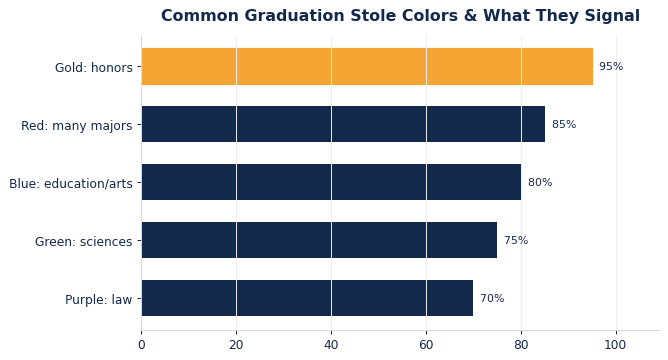
Because conventions vary, always confirm your institution’s own color guide before ordering a large run — a quick check prevents a mismatch on stage.
What schools order stoles for
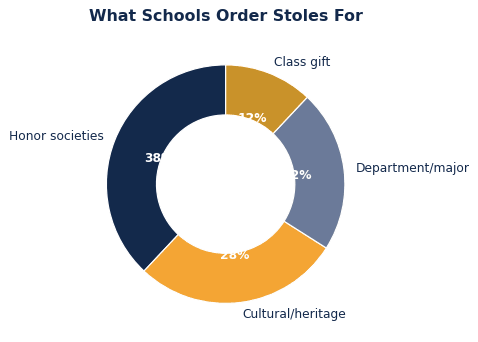
Honor societies drive the most stole orders, followed by cultural and heritage recognition, departmental identity, and class gifts. The breakdown below reflects typical orders.
Customizing color with text and emblems
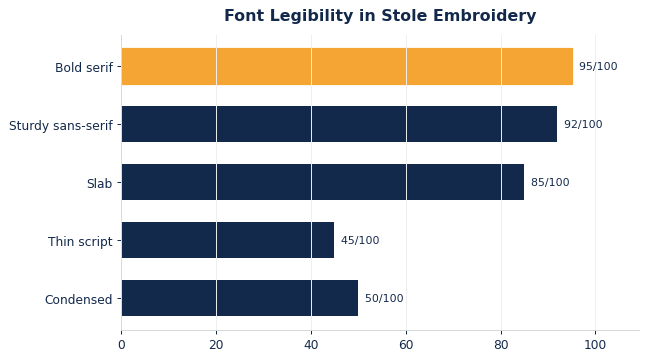
Beyond the base color, embroidery adds names, years, Greek letters, or emblems. Choose thread colors that contrast the stole so text reads from the audience, and keep emblem sizes consistent across a group order for a clean look.
| Color | Common meaning | Note |
|---|---|---|
| Gold | Honors | Most recognized |
| Blue | Education/arts | Varies by school |
| Green | Sciences/medicine | Varies by school |
| Custom | Cultural/org | Set by group |
Ordering for a specific program? See our companion guide, our Custom Graduation Stoles for Nursing & Allied Health Programs. Explore our custom graduation stoles or contact our team.
Cultural and heritage stole colors
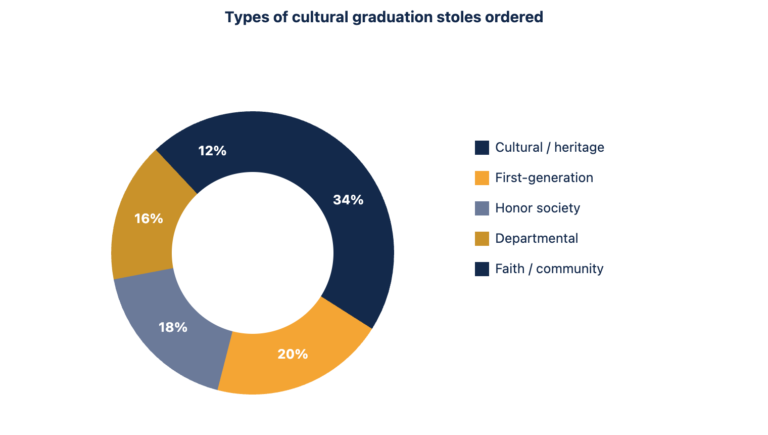
Beyond academic conventions, many graduation stole colors carry cultural, national, or organizational meaning, and these are often the most personal pieces on the stage. Heritage stoles use colors, patterns, and symbols meaningful to a community — Kente cloth for African and African American heritage, serape patterns for Latino graduates, or specific flag colors for international students. Because these meanings are defined by the community and the wearer rather than a universal chart, the color choice is a statement of identity as much as achievement.
When a school orders heritage stoles, the goal is to honor the specific tradition accurately, so it pays to confirm colors, patterns, and any lettering with the students or groups involved. A respectful, well-made heritage stole becomes a treasured keepsake, and getting the details right — the exact shade, the correct symbol placement — is what makes it feel authentic rather than generic.
Coordinating stoles across a ceremony
A commencement looks its best when the stoles read as a coherent system even while they signal different achievements. Standardizing the stole length, fabric, and trim across your school, and varying only the color and embroidery, keeps the whole stage unified in photos while still letting honors, departments, and cultural groups stand apart. That consistency also simplifies ordering, since one base stole in several colors is easier to buy and manage than many different styles.
Coordination matters most when a single graduate wears more than one recognition. Deciding in advance how honor cords, multiple stoles, and pins are worn together prevents a cluttered look and ensures each distinction is visible. A simple guideline shared with graduates — which stole goes on top, how cords are draped — keeps the ceremony polished and every achievement legible from the audience.
Ordering the right colors and quantities
Because stole color is not universally standardized, the safest path is to confirm your own institution’s color guide before ordering a large run, then match dye lots so every stole in a group looks identical. Order a small overage to cover last-minute additions and replacements, and lock artwork and colors early enough to allow for a proof and production before the ceremony date, which fills up fast in the spring graduation rush.
For schools buying across several groups at once, a shared spec — base stole, fabric, length, and the color and embroidery for each group — turns reorders into a simple repeat and keeps costs predictable. Per-stole pricing improves with volume, so consolidating the order rather than scattering small runs is the efficient way to outfit an entire graduating class.
Embroidery and personalization on colored stoles
Once the base color is set, embroidery is what turns a stole into a personal, finished piece. Names, graduation years, Greek letters, emblems, and short phrases all read cleanly when the thread color contrasts the stole, so a light thread on a dark stole or a rich thread on a pale one keeps the lettering legible from the audience. Keeping emblem sizes and placement consistent across a group order is what makes a row of stoles look like a designed set rather than a collection of one-offs.
Personalization also lets a single base color serve several purposes. A department can share one stole color while individual graduates add their own names, or an honor society can use a common gold stole with each member’s year embroidered discreetly. That flexibility means you can standardize the color for a unified look while still giving each graduate something that feels made for them, which is exactly the balance most schools want on stage.
Because embroidery is permanent, a quick proof is worth the wait. Confirming the spelling of names, the exact Greek letters, and the placement before a full run prevents the costly mistake of a boxed set with an error repeated across every stole. A five-minute review protects both the budget and the keepsake quality families expect from graduation regalia.
Common questions about graduation stole colors
Are graduation stole colors standardized?
No. While there are broad conventions — gold for honors, certain colors for fields of study — each institution and organization sets its own meanings. Always confirm your school’s color guide before ordering so the stoles match your specific tradition.
What does a gold graduation stole mean?
Gold most commonly signals academic honors, such as membership in an honor society or graduating with distinction. Because conventions vary, verify how your institution uses gold before assigning it, especially on a large order.
Can we create custom stole colors for cultural groups?
Yes. Heritage and cultural stoles use colors, patterns, and symbols meaningful to a community, defined by the group rather than a universal chart. Confirm the exact colors, patterns, and any lettering with the students involved so the stole honors the tradition accurately.
How should stole colors coordinate across a ceremony?
Standardize the stole length, fabric, and trim, and vary only the color and embroidery, so the stage reads as one system while still distinguishing honors, departments, and cultural groups. This also simplifies ordering and keeps costs down.
Choosing stoles for your ceremony?
We’ll match colors, embroidery, and quantities to your program’s tradition.
Get a Quote