Embroidery, Screen Print, or Sublimation: Decorating Custom Graduation Stoles
When people compare ways to decorate apparel, the argument usually turns on how many washes the design survives. A graduation stole quietly breaks that rule: it is worn for a few hours on one important day and then kept as a keepsake, not laundered week after week. That single fact reshapes the decision. Instead of chasing maximum wash durability, choosing how to put a name, year, logo, or crest on a stole comes down to the look you want, the colors and artwork involved, the fabric, and how many you are ordering. Here is how the main methods actually compare for a stole.
The one thing that changes the calculus
On workwear, embroidery’s edge is stark. Polyester embroidery thread can shrug off 500 or more wash cycles, while a screen print with standard plastisol ink often starts to fade somewhere around 40 to 60 washes. For a uniform that matters enormously. For a stole that may never see a washing machine, it mostly does not. What survives the day matters, and all of these methods clear that bar easily, so durability moves from the deciding factor to a tiebreaker. That frees you to choose on appearance, artwork, and cost instead, which is where the methods genuinely differ.
Embroidery: the premium, dimensional default
Embroidery stitches the design directly into the stole with thread, giving it a raised, dimensional texture that reads as high-value the moment it is seen and touched. It is the strongest choice for names, graduation years, Greek letters, and clean logos, and because the cost is driven by stitch count rather than color count, a multi-color monogram carries no per-color penalty. Its limits are real, though: embroidery cannot reproduce photographs or smooth gradients, and very small text or fine lines can lose legibility, so a practical floor is around a 5-millimeter letter height. Very large filled designs also become impractical because they require dense, heavy stitching. The one-time setup is a digitizing fee to convert artwork into a stitch file, which commonly falls in roughly the 40 to 100 dollar range regardless of vendor, after which each additional stole is inexpensive to run.
Screen printing: bold graphics at volume
Screen printing pushes ink through a stencil, one screen per color, and it shines when you have a bold graphic or a large solid design and a lot of stoles to make. Each color needs its own screen, and that setup commonly runs on the order of 25 to 75 dollars per color as a one-time charge, which is why screen printing is uneconomical for a handful of pieces but becomes very cost-effective once the quantity climbs. It handles fine detail and crisp edges well on a flat area, though it is less suited to photographic imagery than digital methods. For a school ordering hundreds of matching stoles with a two or three-color emblem, it is often the most economical route per unit.
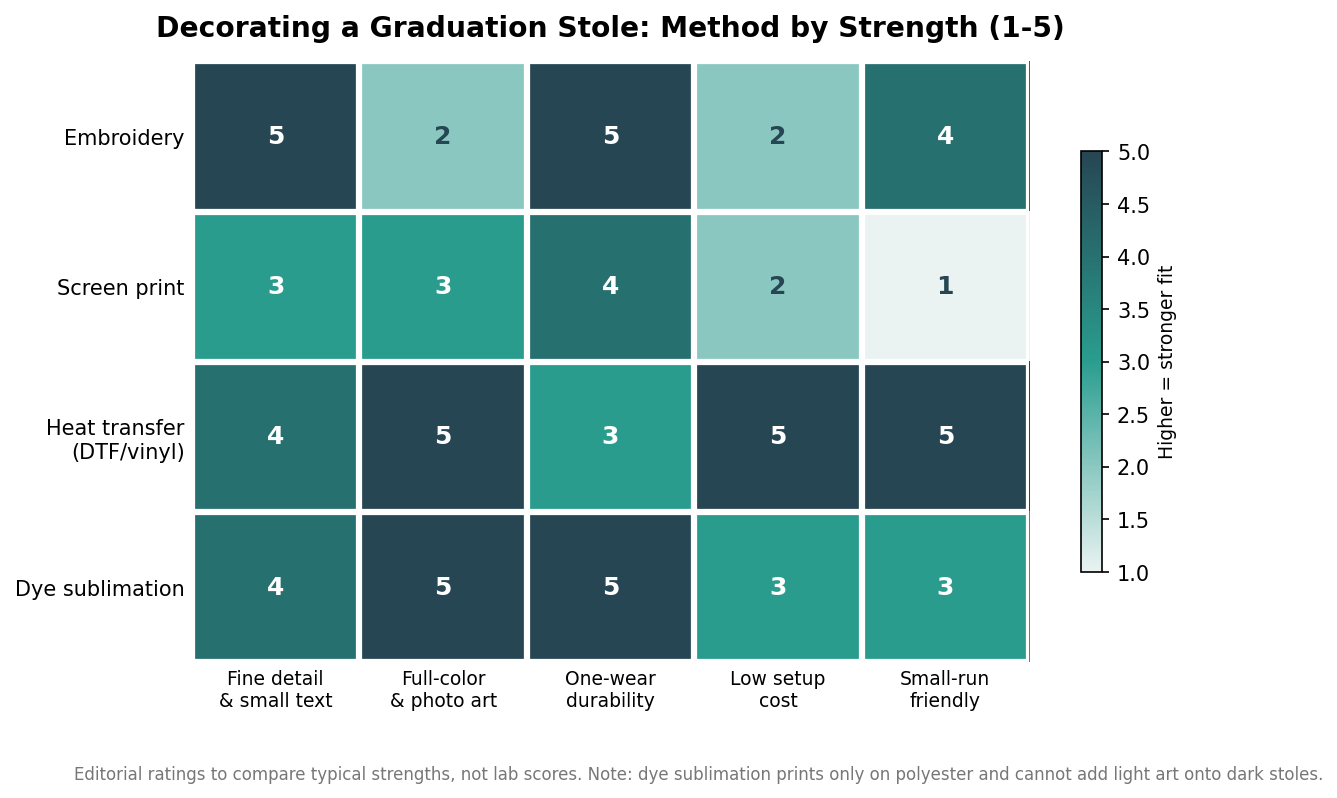
The matrix above sums up where each method is strong. No single row wins everywhere, which is the point: the right method depends on what you are decorating and how many you need, not on one universal best.
Heat transfer and sublimation: the full-color routes
Heat transfer, including modern direct-to-film and vinyl, presses a printed design onto the stole with heat. It carries little or no per-color setup, so it is the friendliest option for small runs and one-off personalization, and it reproduces full color and photographic art that embroidery cannot. The trade is that a transfer sits on top of the fabric rather than in it, so it is the least durable of the group over heavy use, which, again, matters little for a once-worn stole. Dye sublimation takes the opposite approach: the design is infused into the fibers so it becomes part of the fabric, permanent and impossible to crack or peel, and it can print edge to edge in unlimited color. Its catch is a hard material rule. Sublimation only works on polyester and only prints well onto white or light fabric, because the process adds dye rather than opaque ink and cannot lay light artwork over a dark stole. For a white or light polyester stole with a full-color or all-over design, it is superb; for a dark stole, it is off the table.
Letting quantity and color decide
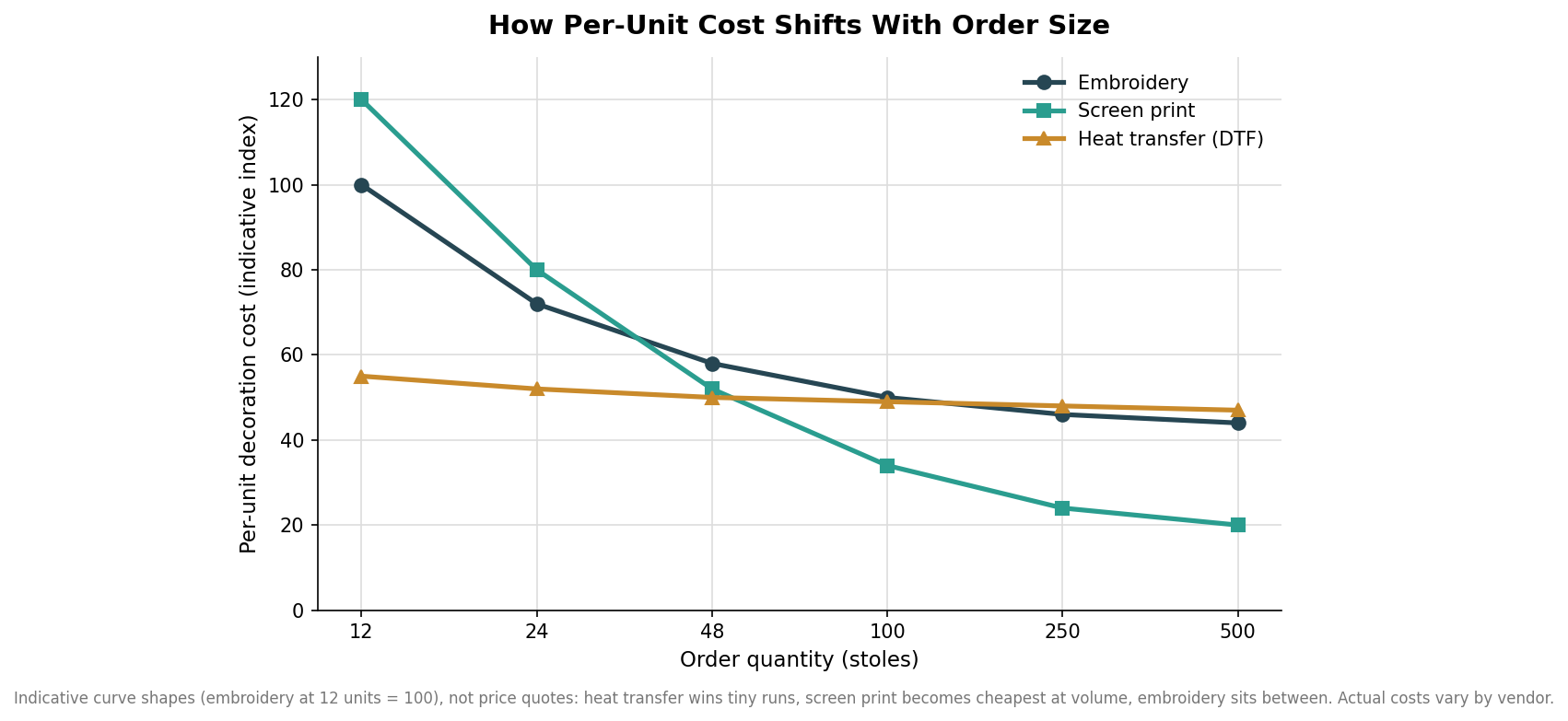
Put the setup structures together and a clear pattern emerges across order size. For very small runs and individual names, heat transfer usually wins because it barely has a setup cost to amortize. As quantity rises, screen printing’s per-color setup spreads across more units until it becomes the cheapest per stole at volume. Embroidery tends to sit between the two, with its digitizing fee amortizing quickly and its per-unit cost staying moderate and flat. The chart below shows those indicative curve shapes, and while the exact figures depend on the vendor, the crossovers are the part worth internalizing.
Color and artwork narrow it further. A simple name or crest in one or two colors on a modest number of stoles points to embroidery for feel or heat transfer for economy. A large, bold, few-color graphic across hundreds of stoles points to screen printing. A photographic or all-over full-color design points to sublimation, provided the stole is light polyester. And a dark stole rules sublimation out, sending full-color work to heat transfer instead.
The most reliable way to choose is to answer three questions in order: what does the artwork demand, what color and fabric is the stole, and how many are you ordering. Let those drive the method rather than defaulting to whatever is most durable, because on a garment worn once and then treasured, the look on the day is what the graduate remembers.