Custom Grad Stoles: 2026 Pricing, MOQs & Lead Times
If you’ve started pricing out custom grad stoles for your graduating class, honor society, or Greek chapter, you’ve probably noticed the numbers all over the place — some sites quote under $6 a stole, others quote near $30. The gap usually comes down to three things: how the stole is decorated, how many you’re ordering, and whether you’re buying from a manufacturer or a middleman. None of that is obvious until you’re deep into a quote request.
This guide walks through what custom grad stoles actually cost at wholesale versus retail, what minimum order quantities and production timelines look like across suppliers, and how embroidery, screen print, and fabric choices change your per-unit price. The goal is to get you to an accurate budget and a realistic order date before you commit.
Whether you’re ordering a dozen stoles for an honor society or several hundred for a graduating class, the math below should get you within a few dollars of what you’ll actually pay.
Source: Gradshop.com and Tassel n Fringe (tasselnfringe.com) pricing and FAQ pages, accessed August 2026
How much do custom grad stoles cost?
Price is driven almost entirely by decoration method once you’re buying in any real quantity. Wholesale pricing puts a plain, undecorated satin stole at around $3 per unit. Add embroidery to one side — typically the front panel with a school name, Greek letters, or society crest — and the price moves to roughly $5.99 per stole. Embroidering both sides, which most honor societies and Greek chapters want so the design reads correctly whichever way the stole drapes, runs about $6.99 per stole.
Those figures are wholesale numbers. If you buy custom grad stoles through a retail-facing graduation supplier rather than a manufacturer, expect to pay considerably more for the same embroidery — anywhere from about $8 to $28 per unit depending on the vendor and how much of that price is covering marketing and customer service rather than production. If your order is large enough to justify it, going direct to a manufacturer or wholesaler is where the real savings show up.
Screen printing and heat-transfer designs generally undercut embroidery on price but don’t hold up as well over repeated wear, which matters less for a one-time graduation stole than it would for something worn season after season.
Minimum orders and lead times, supplier by supplier
One of the more surprising things about ordering custom grad stoles is how low the minimums actually are. Gradshop sets its minimum order quantity at just 6 stoles for standard custom designs, which makes it workable for a small honor society or a handful of student leaders rather than only large graduating classes. GraduationSource sets its minimum a bit higher, at 10 stoles, and pairs that with a design-approval process where a product designer works directly with you before production starts.
Lead time is the number that trips up more buyers than price does. Gradshop quotes 12-15 business days for standard processing, with rush options available on request. GraduationSource quotes roughly 2-3 weeks from the point you approve your design proof — not from the day you place the order — to the day the stoles ship. That distinction matters: if your proof goes back and forth for revisions, your clock doesn’t start until you sign off on the final version.
| Supplier | Minimum order | Production lead time |
|---|---|---|
| Gradshop | 6 stoles | 12-15 business days after art approval |
| GraduationSource | 10 stoles | 2-3 weeks after proof approval |
Embroidery vs. screen print vs. sublimation
Embroidery is the standard for custom grad stoles because it holds its shape and color through the wear a stole gets during a ceremony, photos, and being handled by family afterward as a keepsake. It’s also what most honor societies and universities require for official regalia, since raised stitching reads as more formal than a printed graphic.
Screen printing is faster to produce and cheaper per unit for large flat-color designs, but it sits on top of the fabric rather than being woven into it, so it can crack or fade with repeated folding and storage. Sublimation printing, which dyes the design directly into polyester fabric, holds up better than screen print and works well for full-color photographic designs or gradients that embroidery can’t reproduce cleanly — but it only works on polyester or poly-blend stoles, not natural fibers.
For a one-and-done graduation stole, either method is durable enough. The decision usually comes down to how detailed your artwork is: simple text and crests favor embroidery, multi-color logos or photo-based designs favor sublimation.
Satin vs. velvet stoles
Satin is the default fabric for custom grad stoles — it takes embroidery cleanly, drapes well over a gown, and is the cheapest base fabric to source. Velvet stoles cost more and are heavier, which some honor societies prefer for a more formal look, but they add weight and cost to an order without changing the embroidery price much.
Trim and fringe options
Fringe trim on the bottom edge is a common upgrade for honor stoles and typically adds a small per-unit cost over a plain hemmed edge. If your group is ordering both member stoles and a small number of officer or leadership stoles, it’s worth asking whether trim can be limited to just the officer set to control cost.
Timing your order around graduation season
Custom grad stoles cluster around two demand spikes: May-June for spring commencements and December for fall/winter ceremonies. Suppliers’ quoted lead times assume normal capacity — during the six weeks before a major graduation date, actual turnaround can run longer than the standard 12-15 business days, and rush fees climb accordingly.
The safest window to place an order is 6-8 weeks before your ceremony. That leaves room for a first proof, at least one round of revisions, standard production time, and shipping, without paying rush premiums. If you’re ordering fewer than 3-4 weeks out, call the supplier before you submit artwork — some will tell you upfront whether your date is even reachable at standard pricing.
Coordinating a group order without losing your mind
Most custom grad stole orders aren’t one person buying one stole — they’re a class officer, faculty advisor, or chapter president collecting names, sizes, and payment from a group before placing a single bulk order. A few habits make this less painful. Lock the design and colors before you open the order to the group; changing artwork after people have already paid creates refund headaches. Collect names for individual embroidery (if you’re doing personalized name stoles rather than a single stock design) in one spreadsheet with a hard cutoff date, and build that cutoff around the supplier’s proof-approval lead time, not your ceremony date.
If your group includes both a large general membership and a smaller leadership tier with different trim or wording, ask whether the supplier can run both as one combined order — splitting into two separate orders usually means paying two separate setup costs and, in some cases, missing the minimum order quantity on the smaller batch.
Frequently asked questions
What’s the minimum order for custom grad stoles?
It varies by supplier, but it’s lower than most buyers expect. Gradshop’s minimum is 6 stoles for a standard custom design; GraduationSource requires 10. Small honor societies and individual chapters can typically order without hitting a wall on minimums.
How much does embroidery add to the cost of a stole?
At wholesale pricing, a blank stole runs about $3, one-side embroidery brings it to roughly $5.99, and two-side embroidery runs about $6.99. Retail-facing suppliers charge more for the same work, sometimes $8-$28 per unit, so it’s worth comparing a wholesale quote before committing.
How far in advance should I order custom grad stoles?
Order 6-8 weeks before your ceremony if possible. Standard production is 12-15 business days after you approve your design proof, but proof revisions and peak-season demand around May-June and December can push that out, and rush orders typically cost more.
Should I choose embroidery or screen printing for a graduation stole?
Embroidery is the standard for grad stoles and is what most schools and honor societies expect for official regalia — it holds up better through handling and looks more formal. Screen printing is cheaper for large, simple designs, and sublimation works better than either for full-color or photo-based artwork, but only on polyester fabric.
Can I order a small batch, like under 10 stoles, for an honor society?
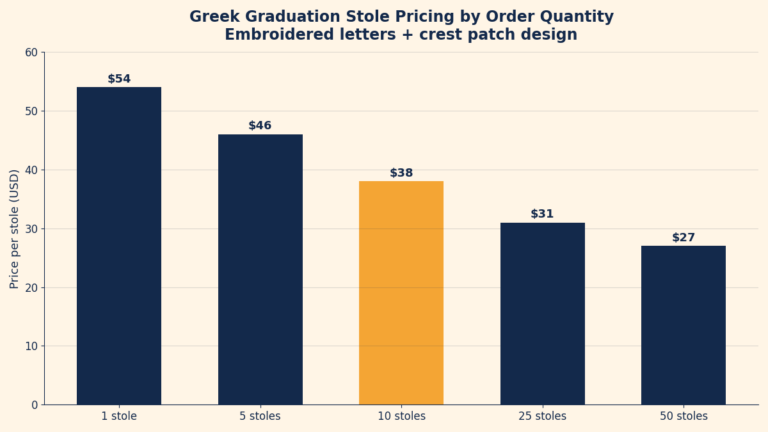
Yes. Suppliers like Gradshop set their minimum as low as 6 stoles specifically because honor societies and small leadership groups order in that range regularly. You may pay a slightly higher per-unit price than a class-wide order of hundreds, but it’s still workable at wholesale pricing.
The bottom line
The range in custom grad stoles pricing you’ll see online isn’t random — it tracks directly to decoration method, order size, and whether you’re buying wholesale or retail. Budget around $6-$7 per stole for embroidered wholesale pricing, plan for a 2-3 week turnaround from proof approval to shipment, and place your order 6-8 weeks out from your ceremony to avoid rush fees. Get those three numbers right and the rest of the order — colors, trim, names — is the easy part.