The Stole of Gratitude: What It Is and How to Order One for Your Class
Most graduation regalia marks what the graduate earned. The stole of gratitude flips that around: it is a stole the graduate gives away, to the parent, mentor, teacher, or family member who helped make the day possible. It is a newer tradition than the tasseled cap or the honor cord, but it has spread quickly through high schools and universities, and for a school or organization placing a bulk order it behaves differently from an ordinary achievement stole. This guide covers what the piece is, how to design one that reads as a keepsake, and how to order a run of them for a whole class without the timeline or the budget getting away from you.
What a stole of gratitude actually is
A stole of gratitude is a ceremonial sash, usually in the school’s colors, that a graduate presents to someone who supported them on the way to the diploma. The presentation is the whole point: it commonly happens right after the ceremony or in a quieter private moment, when the graduate drapes the stole over the shoulders of a parent, guardian, sibling, teacher, or mentor as a public thank-you. Recipients often keep it as a lasting memento, and a large share end up in a shadow box on a wall rather than folded in a drawer, which is worth remembering when you think about how the piece should look up close.
Because it is a recognition of a person rather than an academic achievement, the design language is warmer than a departmental or honor-society stole. Many are embroidered with a simple message of thanks, the graduation year, and the school name or seal; others are left deliberately plain so the graduate can write a personal note directly on the fabric with a permanent marker. Neither approach is more correct. The embroidered version photographs cleanly and lasts, while the blank version invites a handwritten message that a recipient may treasure more than any stitching.
How it differs from a regular graduation stole
In physical form, a stole of gratitude is essentially identical to a standard graduation stole; someone glancing across a room would not tell them apart. Both are typically around 72 inches long so they hang evenly to about knee level, and both run roughly four to six inches wide, with either a straight or a pointed V-shaped back. The fabric is usually the same bright or matte satin used for achievement stoles. What changes is the intent and, with it, a few practical choices.
The biggest difference is who wears it and for how long. An achievement stole is sized and colored for the graduate and worn through the ceremony; a gratitude stole is worn by an adult recipient, often briefly, and then displayed. That nudges the design toward legibility at conversational distance and toward a message that will still make sense years later on a wall. It also means you are usually ordering one gratitude stole per graduate who wants to participate, which is a different quantity math than the class-wide achievement stoles, since not every graduate will choose to give one.
Designing one that works as a keepsake
Start with the message, because it drives everything else. A short, legible line such as a thank-you with the year reads far better in embroidery than a long sentence that shrinks the lettering to fit the narrow width of a stole. If you want the freedom of a longer, personal note, specify a blank or lightly branded stole and let the graduate handwrite it; just confirm the fabric takes permanent marker cleanly, because some slick satins bead up. Keep any embroidered text on the lower third of each leg where it sits at chest height on the recipient, and hold logos and seals to a size that survives being read from a few feet away.
Color is the other lever. School colors are the safe and traditional choice, and they tie the gift visually to the ceremony, but a gratitude stole gives you a little more license to pick the shade that photographs best under gymnasium or outdoor lighting rather than matching a strict regalia code. Whatever you choose, decide between embroidery and full-color sublimation early, because the two methods have different minimum text sizes and different color behavior, and switching between them late tends to force an artwork redo. Where this guide gives a dimension or a size as typical, treat it as a starting point and confirm the exact measurements against the specific stole you are quoting.
Ordering a run for a class or group
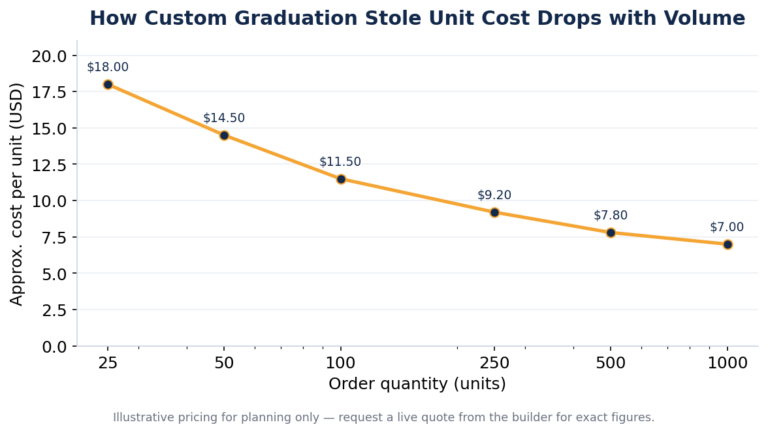
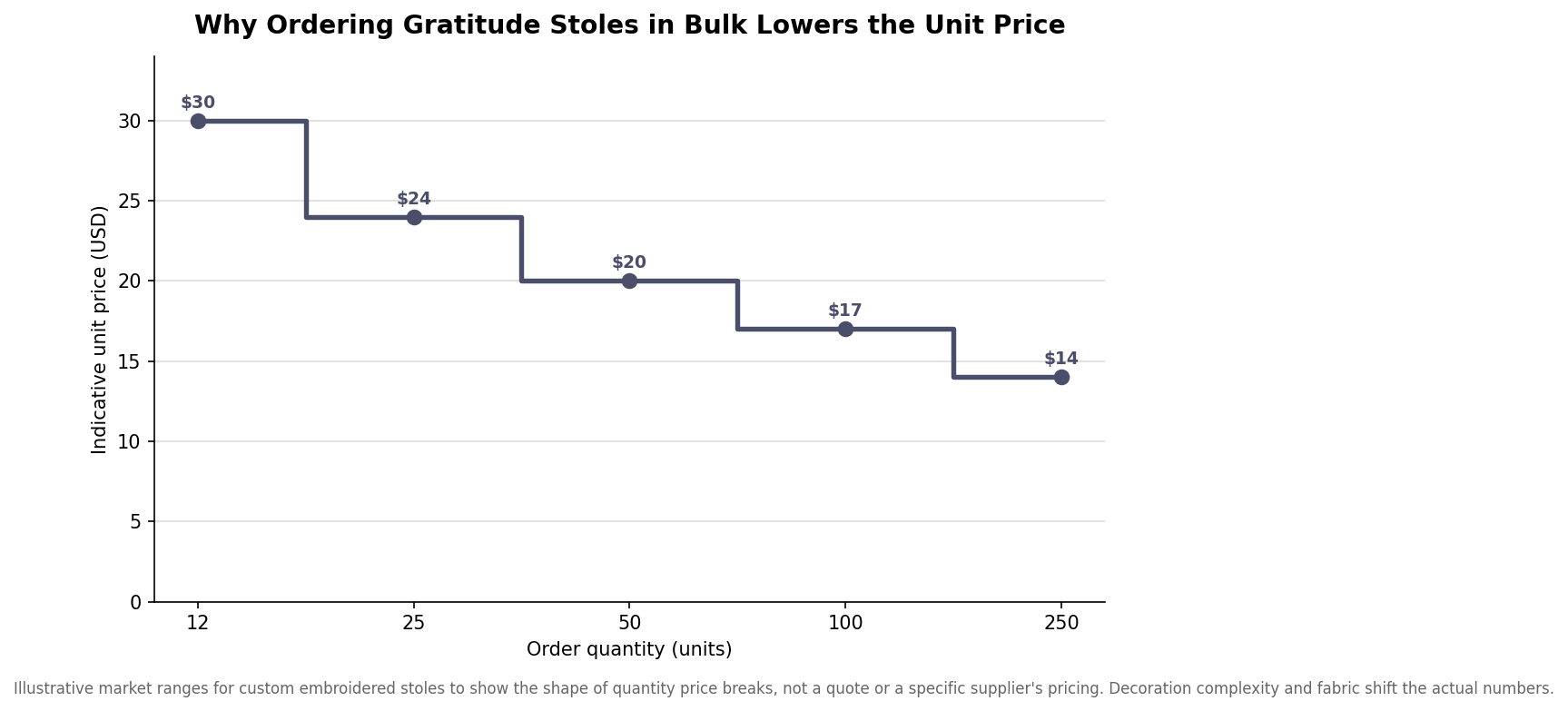
The economics of a bulk order reward planning. Custom embroidered stoles get cheaper per unit as the quantity climbs, and the drop from a dozen to a few hundred is steep enough that it is worth polling graduates early to size the order accurately rather than reordering a small top-up later at a higher unit price. The chart below shows the general shape of those quantity breaks; the exact numbers depend on decoration and fabric, so use it to understand the curve, not as a quote.
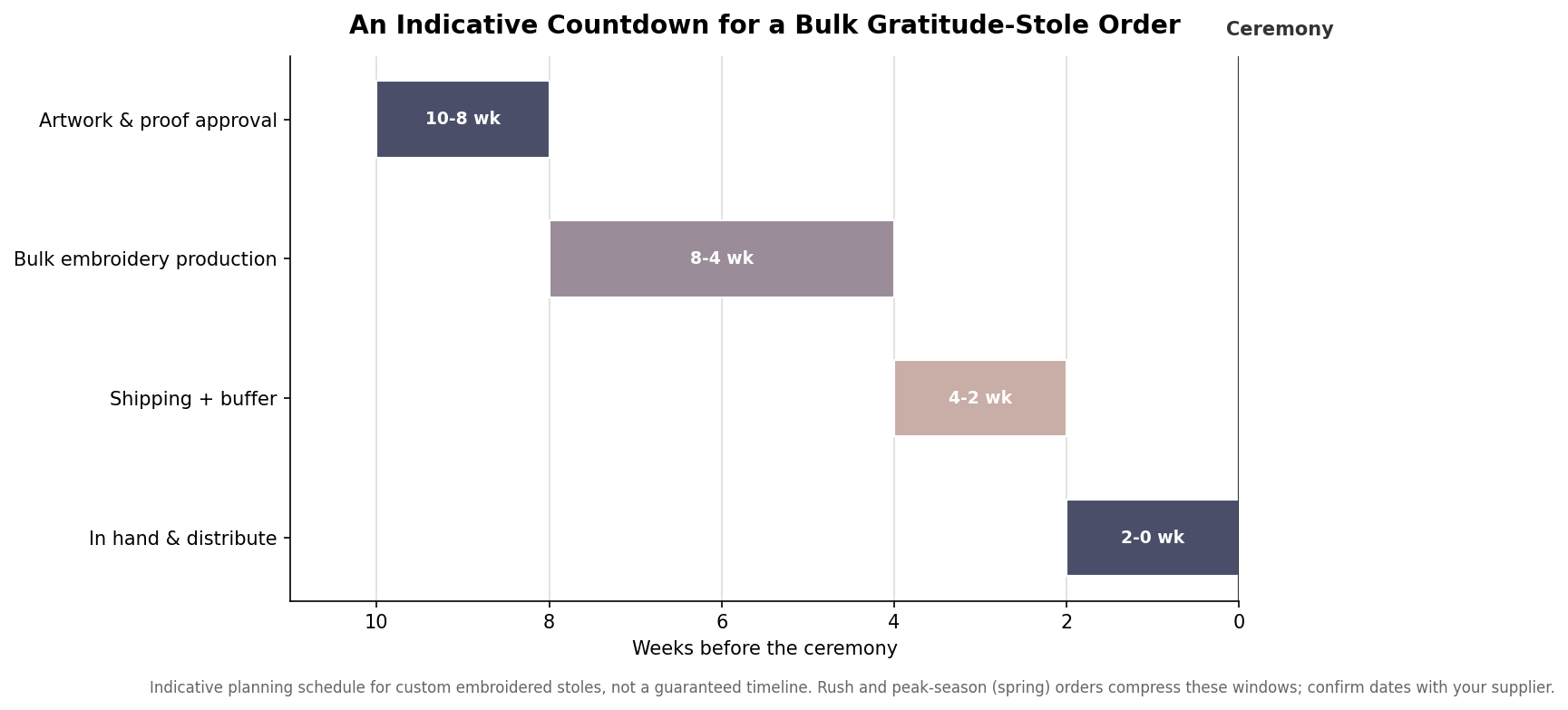
Timeline is the other place bulk orders go wrong, and gratitude stoles inherit the same spring crunch as the rest of graduation season. As an indicative plan, give yourself around ten weeks: a couple of weeks to settle artwork and approve a proof, roughly four weeks for bulk embroidery production, and a two-week shipping and inspection buffer so the stoles are physically in hand well before the ceremony rather than arriving the night before. Build in a modest overage, because a handful of graduates always decide late that they want one, and a few spare stoles are far cheaper than a rush reorder. Peak-season and rush jobs compress every one of those windows, so if your date lands in the busy spring stretch, start earlier than feels necessary and confirm the production calendar with your supplier before you commit the full quantity.